Published: 11/10/2026
The global health sector spurs economic growth, creates jobs, drives demand for innovative health products developed in the state and helps California detect disease outbreaks
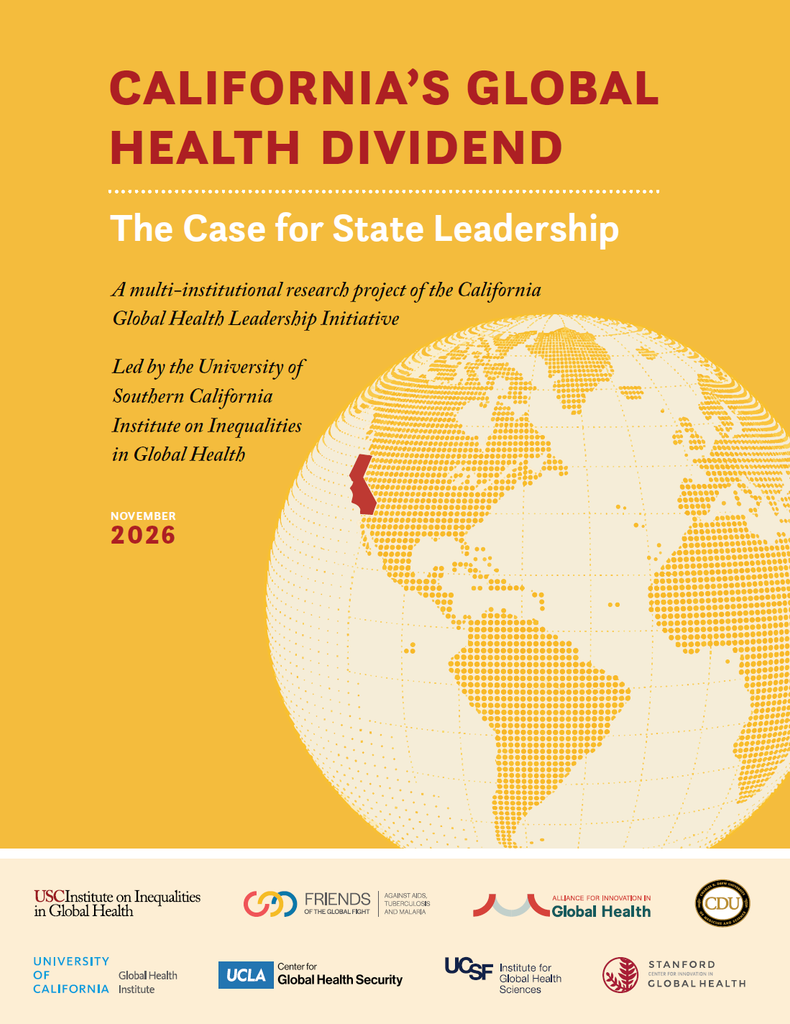
A new analysis, “California’s Global Health Dividend: the case for state leadership,” was released on Nov. 9 by eight organizations, including the Stanford Center for Innovation in Global Health. It is available here.
The analysis is led by the University of Southern California Institute on Inequalities in Global Health.
Drawing on disciplines from economics to epidemiology to political science, the study finds that California’s global health dividend reaches communities across the state and generates benefits spanning multiple sectors. Global health grants bolster California’s economy. Global health partnerships generate demand for California products. Global health surveillance helps California authorities detect and respond to biological threats. Global health partnerships influence California’s own health programs.
CIGH Executive Director Amanda Marr Chung, DrPH, reviewed the economics portion of the report. “This is a unique and important study that provides powerful evidence around how federal funding of global health contributes to job creation, innovative products, and our ability to prevent, detect, and respond to disease threats within our state, while also benefiting the world,” she said. “I hope it results in augmented investment by the federal government in global health and convinces the public as to why global health matters.”
CIGH Director Michele Barry, MD, who reviewed the report, said it “makes clear how impactful and beneficial California’s global health work is not only to the state, but also to the world.”
Key findings include:
- Every federal global-health dollar spent in California generates an estimated $1.40 to $2.15 in economic activity, totaling more than $46 billion in the study period.
- Patents arising from global health funding generate billions in estimated private value.
- Federal cuts threaten the co-location of the people and institutions that make California a hub of global health investment
- International purchasing commitments give California companies predictable demand at scale, allowing greater development, investment, manufacture and reach
- California relies on global field programs and monitoring capacity for its outbreak response.
- Global health engagement gives California international influence beyond its formal authority.
Partners on the project:
- Alliance for Innovation in Global Health
- Charles R. Drew University of Medicine and Science Office of International Affairs
- Friends of the Global Fight Against AIDS, Tuberculosis and Malaria
- Stanford Center for Innovation in Global Health
- University of California, San Francisco Institute for Global Health Sciences
- University of California Global Health Institute
- University of California, Los Angeles Center for Global Health Security
- University of Southern California Institute on Inequalities in Global Health